Introduction
During Unit 8, I undertook the comprehensive process of planning, developing, and executing a series of 3D character animations. This unit provided me with the opportunity to explore both the creative and technical dimensions of character performance, with a particular focus on body mechanics, emotional expression, and narrative clarity through motion. For this project, I selected one of my favourite video game characters—Firefly from Honkai: Star Rail—as the subject of my animation studies. The decision to work with an established character was intentional; it allowed me to concentrate on the nuance of performance without the added complexity of original character design, while still maintaining a high standard of visual fidelity and audience recognition.
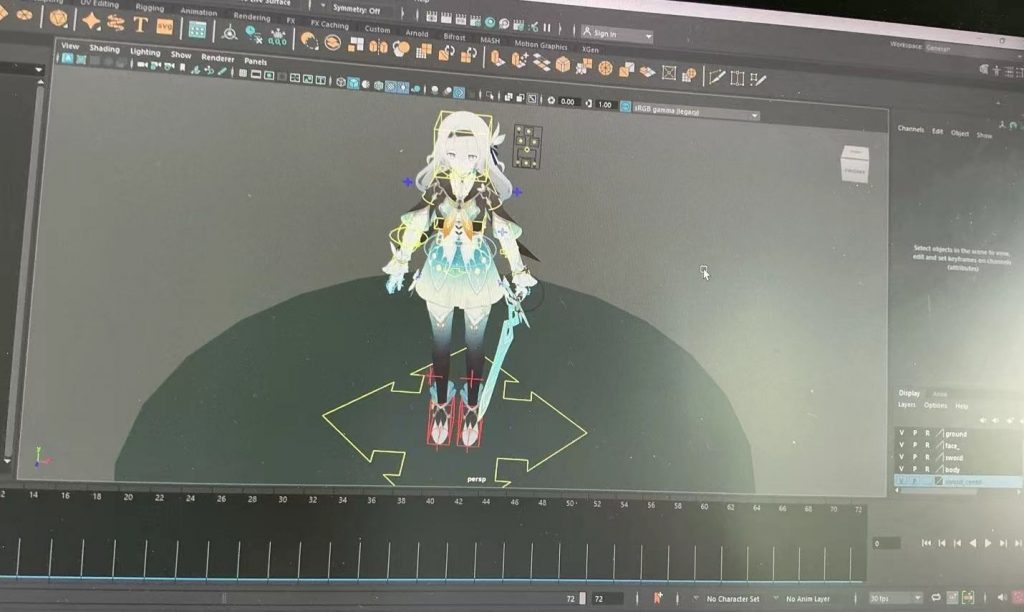
Asset Acquisition and Preparation
Given the constraints of the unit timeline and my current skill level in modelling and rigging, I sourced the character model and rig from a freely available resource on Bilibili. This decision was pragmatic, enabling me to focus my efforts on animation principles rather than technical setup. However, this choice also presented certain challenges. The rig, while functional, was not specifically tailored to my animation needs, and I had to spend considerable time familiarising myself with its control structures, limitations, and quirks. This process, though time-consuming, proved valuable in teaching me the importance of understanding rig mechanics—such as joint hierarchies, IK/FK switching, and control curves—before beginning any meaningful animation work. In a professional context, animators often work with rigs provided by technical departments, and adapting quickly to new systems is an essential skill. This experience reinforced that principle.
Range of Animation Exercises
Over the duration of the unit, in addition to the in-class exercises guided by our tutors, I produced ten distinct animation pieces featuring the Firefly character. These included:
Walk cycle
Run cycle
Jump
Hit/strike action
Skip
Sneak movement
Sad emotional performance
Happy emotional performance
Dancing sequence
Fighting action
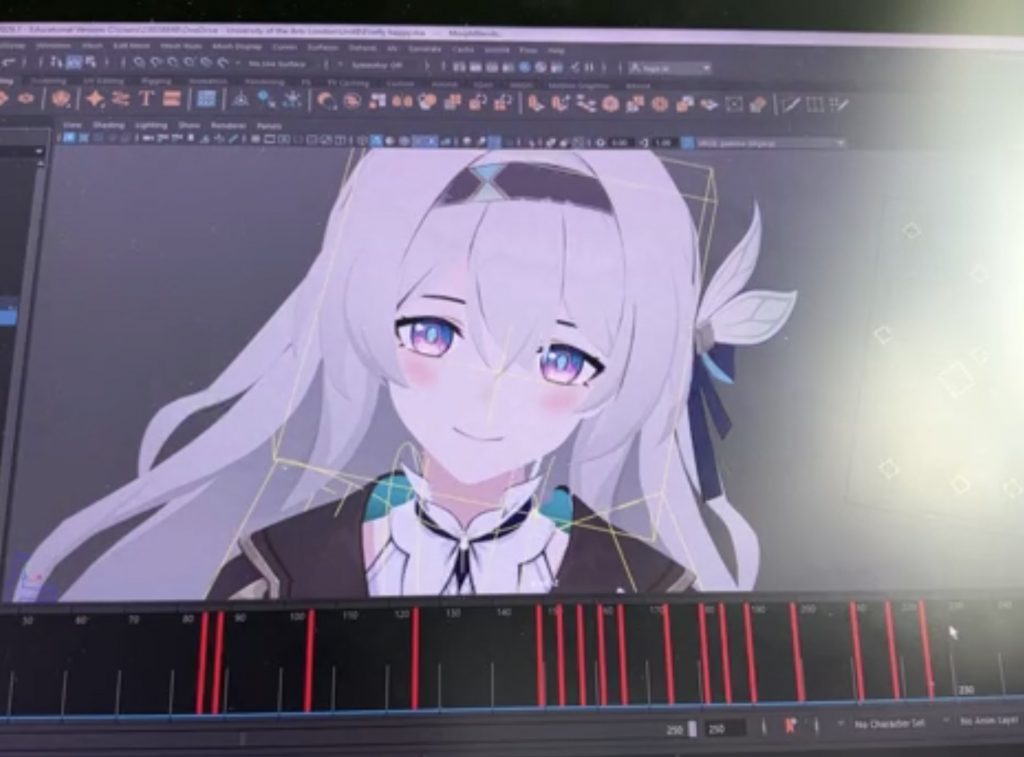
This diverse selection was deliberately chosen to cover a broad spectrum of animation requirements, from fundamental locomotion to complex emotional and combat-driven performances. Each piece demanded a different approach in terms of timing, spacing, posing, and emotional tone, which collectively pushed me to develop a more versatile skill set.
Technical Challenges and Problem-Solving
Throughout the production process, I encountered numerous technical obstacles that tested my understanding of 3D animation principles. The most recurring issues included:
Lack of fluidity: Many of my early animations appeared stiff and mechanical, with abrupt transitions between poses. This was particularly evident in the walk and run cycles, where smooth weight transfer and overlapping action are essential.
Unnatural posing: I struggled initially with creating poses that felt both dynamic and anatomically plausible. Over-extended joints and unbalanced centres of gravity often resulted in performances that looked unconvincing.
Timing and spacing errors: My animations frequently suffered from inconsistent frame distribution, causing movements that either felt too fast, too slow, or lacking in proper ease-in and ease-out.
Speed issues: The overall pace of certain actions, especially the fighting and dancing sequences, did not always match the intended rhythm or emotional beat of the performance.
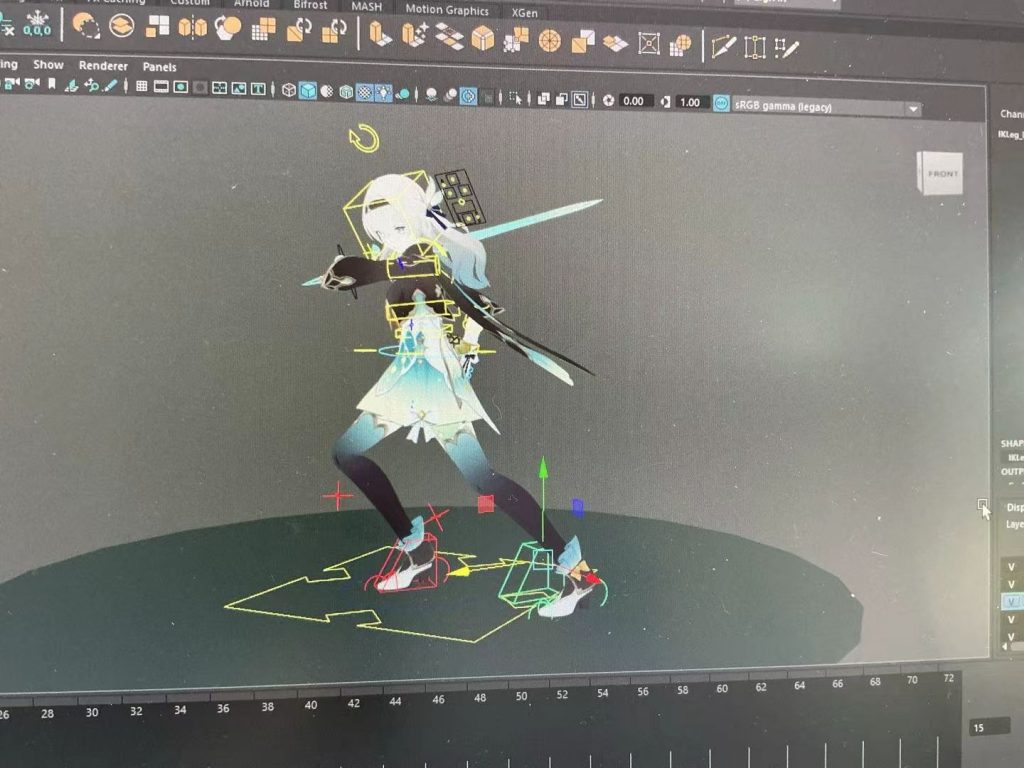
These challenges, while frustrating at the time, were instrumental in my learning journey. With consistent guidance from my tutors, I was introduced to the Graph Editor—a tool I had previously avoided due to its apparent complexity. Learning to manipulate tangent handles, adjust keyframe interpolation, and fine-tune the curve profiles allowed me to address many of the aforementioned issues systematically. For example, by adjusting the tangents of my root control curves, I was able to create smoother weight shifts in the walk cycle. Similarly, by editing the Bézier handles of individual joint rotations, I corrected the unnatural acceleration in my jump animation.
Development of Critical Skills
Beyond the technical use of software, this unit significantly enhanced my ability to analyse and critique my own work. I learned to step back from my animations, view them with fresh eyes, and identify specific areas for improvement. The practice of creating playblasts and reviewing them repeatedly became an essential part of my workflow. I also began to reference live-action footage and other animators’ works more deliberately, using them as benchmarks for realism and stylistic quality.
Moreover, I developed a greater appreciation for the iterative nature of animation. My blocking passes were initially rough and unrefined, but through successive polish passes, each animation gradually gained clarity and personality. The process of moving from stepped to spline interpolation, and later to final polish, taught me the value of patience and systematic refinement.
Emotional and Narrative Performance
Two of the most rewarding animations I produced were the sad and happy emotional performances. These required me to move beyond mechanical motion and consider how subtle changes in posture, facial expression (where possible), and timing could convey internal states. For the sad performance, I utilised slower timing, drooping shoulders, and delayed head movements to communicate melancholy. Conversely, the happy performance featured bouncy timing, extended arm gestures, and quicker recovery actions. These exercises deepened my understanding of how animation functions as a storytelling medium, not merely a technical display.
Time Management and Professional Practice
Working across ten animations within a limited timeframe demanded careful time management and prioritisation. I learned to allocate my efforts based on the complexity and importance of each piece, ensuring that more challenging actions—such as the fighting sequence—received additional iteration time. I also maintained organised project files, annotated my workflows, and documented reference materials, which proved invaluable when revisiting earlier work for refinement.
Conclusion and Future Development
Reflecting on my progress throughout Unit 8, I am proud of the breadth and variety of work I have produced. While each animation has room for improvement, the overall body of work demonstrates a clear trajectory of growth, both technically and creatively. The challenges I faced were not setbacks but stepping stones that taught me resilience, problem-solving, and the importance of fundamental animation principles.
Looking forward, I intend to continue refining my skills in the Graph Editor, explore more advanced rigging techniques, and experiment with facial animation and lip-sync. I also hope to collaborate with other students on future projects to gain exposure to different creative perspectives and workflows. Ultimately, this unit has solidified my passion for character animation and equipped me with the foundational tools necessary to pursue further study and professional practice in the field.
Leave a Reply