JellyFish-Aurelios
Vicky Yang
Student ID: 23028898
I would like to design a symbiotic jellyfish whose structure is divided into three layers: the outer primary jellyfish, which is responsible for hunting; the inner secondary jellyfish, which is responsible for breathing and survival; and several small fish living inside the semi-transparent head of the outer jellyfish, which are responsible for internal protection and cleaning. For me, this is not simply about “designing a jellyfish,” but about creating a complete deep-sea symbiotic ecosystem. This kind of design is inspired by the creatures in ‘Twenty Thousand Leagues Under The Sea’, which combine both scientific imagination and romanticism.
The core concept of this design is:
It is not a single life form, but “multiple organisms forming one shared life.”
I named this jellyfish Aurelios. The name is inspired by Aurelia (a type of jellyfish) and Aureole (a halo of light). It sounds like a creature from an ancient deep-sea alien civilization, which perfectly matches the atmosphere of Twenty Thousand Leagues Under the Sea.
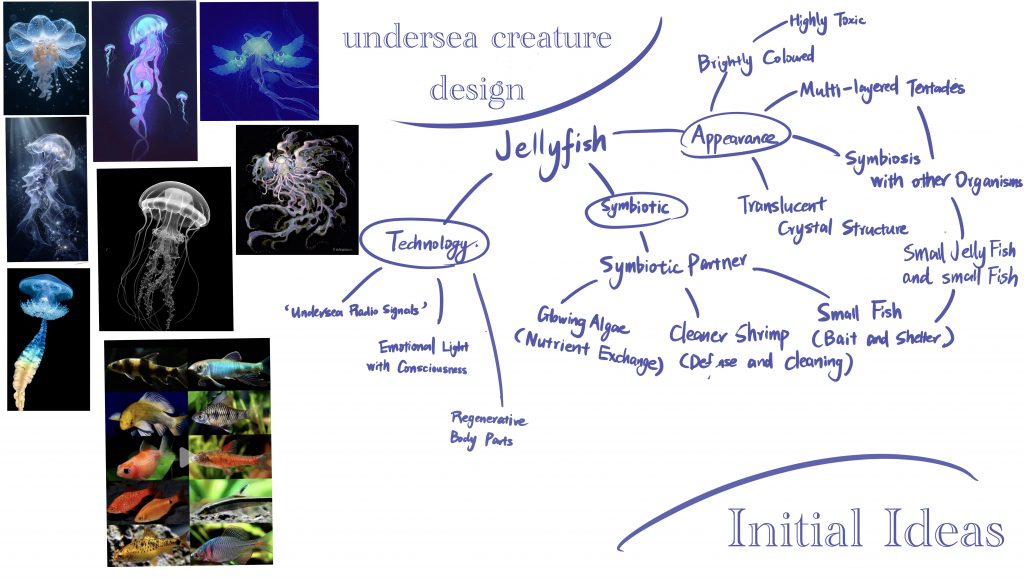
The central idea behind this jellyfish is the concept of a “symbiotic deep-sea jellyfish.” Although it appears to be one giant jellyfish, it is actually divided into three layers: the outer layer functions as an attack system, the middle layer serves as a life-support system, and the inner layer acts as a cleaning and defense system. Together, they resemble a “living marine spaceship.” This idea was inspired by the submarine in Twenty Thousand Leagues Under the Sea.
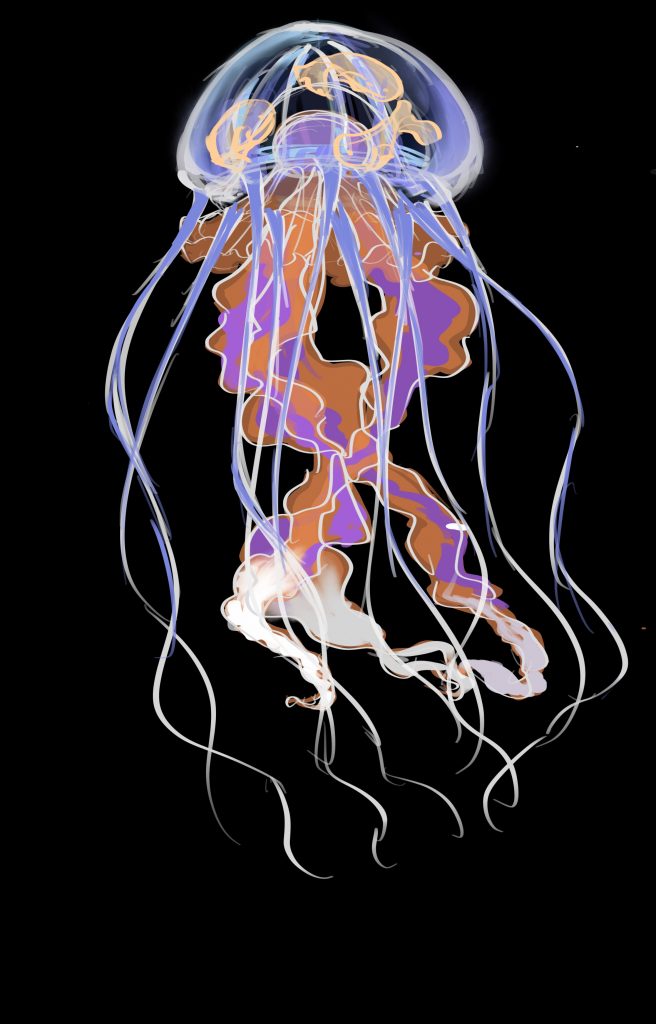
I designed the overall structure of the jellyfish as a “three-layer nested system.”
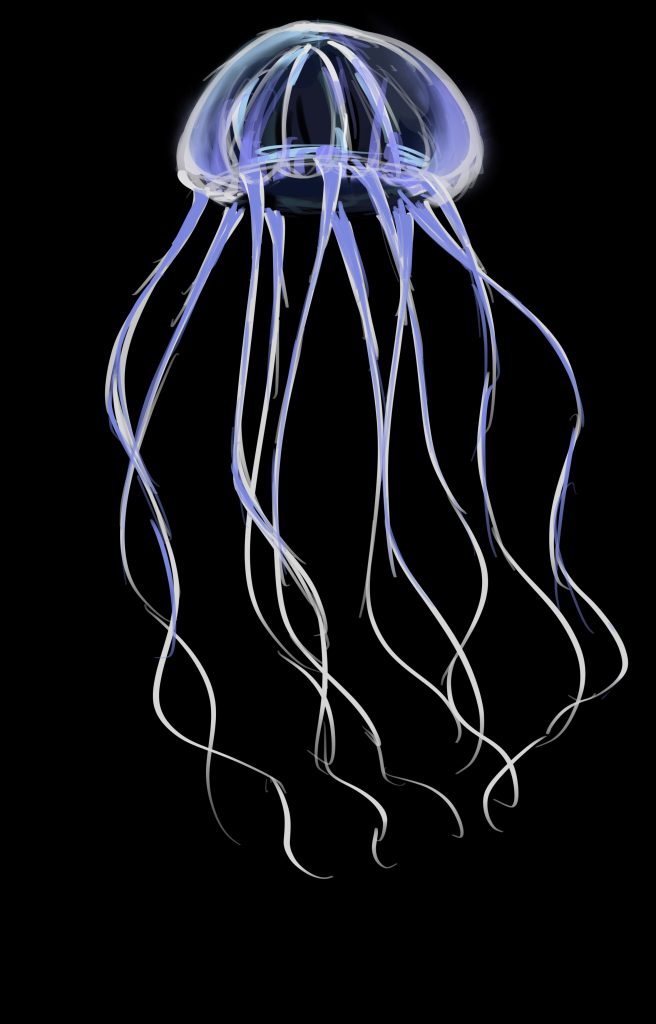
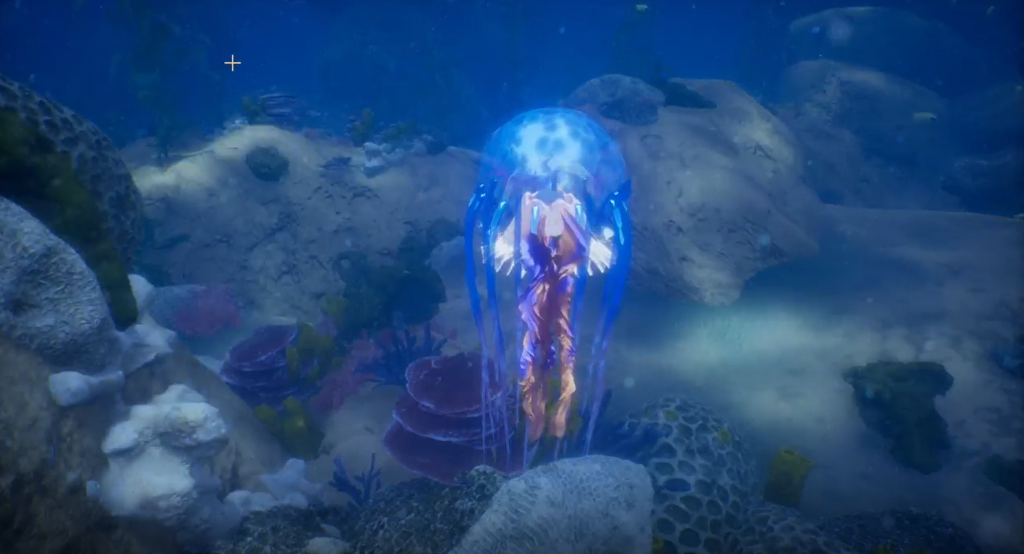
The first layer is the primary jellyfish, called the Outer Hunter. Its functions are hunting, defense, and using bioluminescence to lure and confuse prey. Its appearance is a massive semi-transparent bell, resembling the glowing glass dome of a deep-sea cathedral. The transparency creates a dreamlike quality and allows the internal structures to be clearly visible. Across its surface are flowing, nerve-like luminous veins. Its main tentacles are extremely long, resembling glowing nerves, with venomous stingers at their tips.
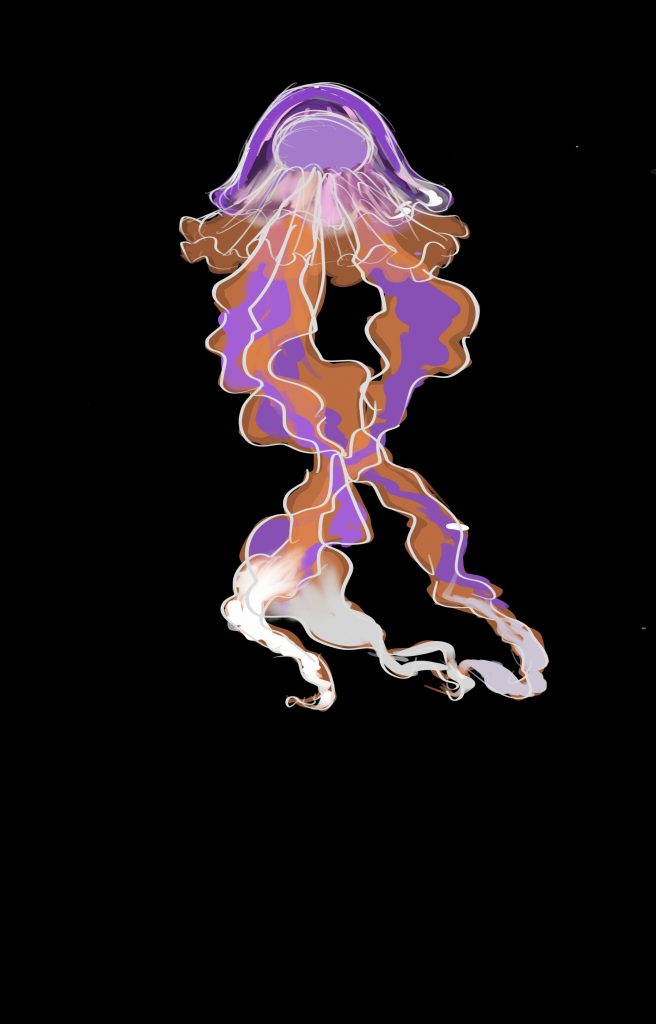
The second layer is the secondary jellyfish, called the Inner Breather. It is not simply an accessory organ, but the true “core jellyfish” that sustains the entire symbiotic organism. Its functions include oxygen circulation, nutrient distribution, regeneration, and energy storage. Its bell is shaped like an upside-down transparent flower. Compared to the outer layer, its appearance is softer and more organic, with rhythmic pulsations that resemble breathing. It slowly opens and closes like a lung. Its color is also noticeably different from that of the outer primary jellyfish.
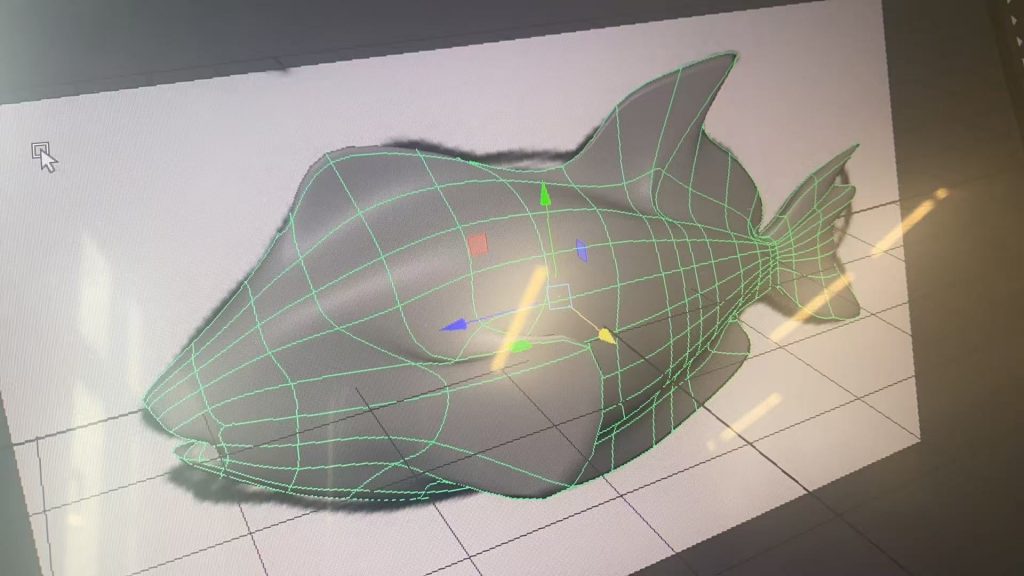
The third layer consists of the symbiotic fish, called the Guardian Fish. Their primary function is cleaning: they consume bacteria, parasites, and dead tissue, similar to real-life cleaner fish. Their second function is defense. When an intruder enters the interior of the bell, the fish begin glowing collectively, swim rapidly, and release electric pulses, forming an “internal immune system.” In appearance, they resemble ordinary small deep-sea fish, but they emit a faint bioluminescent glow.
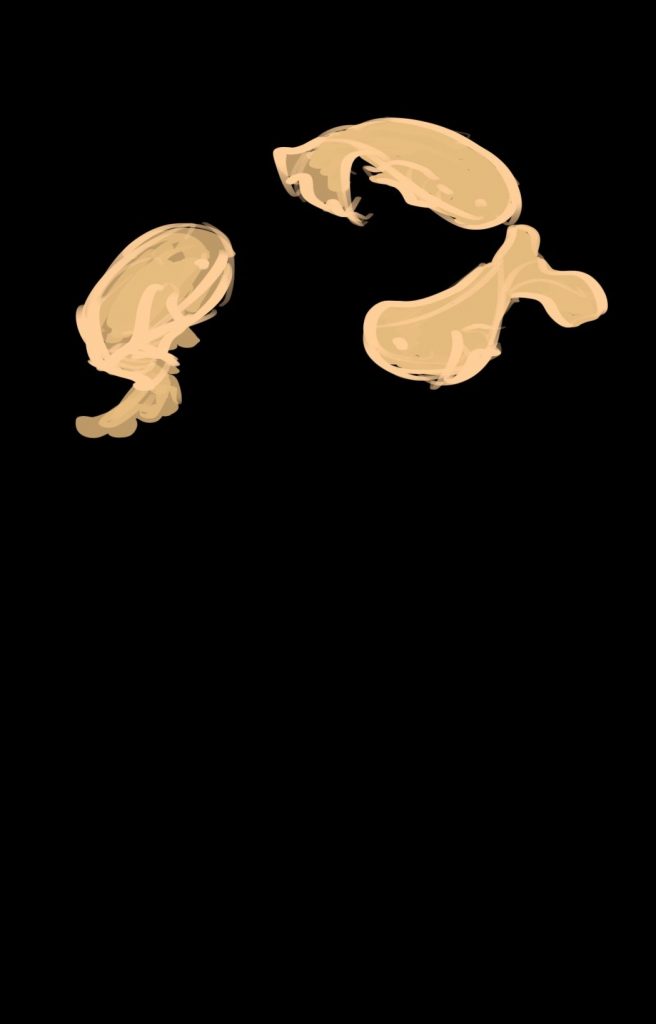
One of the most important aspects of my jellyfish design is that it is not just a single organism, but a “floating ecosystem.” In the deep sea, it is difficult for isolated organisms to survive for long periods of time. Therefore, over millions of years, the primary jellyfish, secondary jellyfish, and symbiotic fish evolved together into an inseparable whole. They share neural signals, bioluminescent systems, and even memory, eventually functioning almost as a single consciousness.
When all of the symbiotic fish die, the entire jellyfish stops glowing, gradually becomes transparent, and finally “dissolves” into the ocean. This is because:
It was never a solitary life form, but a “collective existence.”
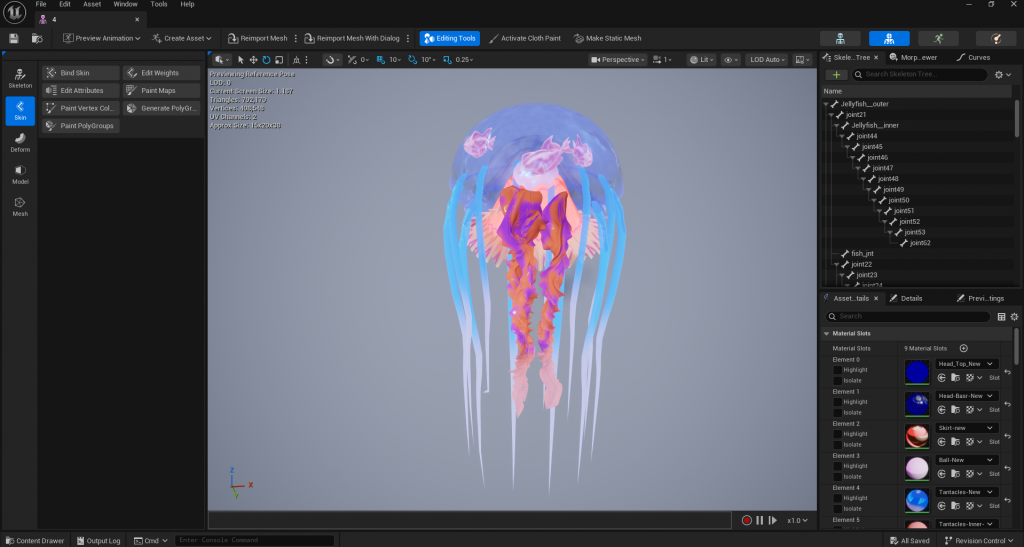
To bring my jellyfish design to life as a 3D model swimming through the ocean, I used Maya to model the two layers of the jellyfish and the small fish inside them. Since it was my first time using Maya, I ran into quite a few difficulties along the way. The inner jellyfish’s tentacles had an irregular, soft spiral shape, and I struggled with how to achieve that look in Maya. Luckily, with my teacher’s help and advice, I took a cylinder, stretched and flattened it, and used the feature in Maya where pressing B lets you rotate and pull the model, combined with the Grab brush, to finally create tentacle shapes that both my teachers and I were very happy with.
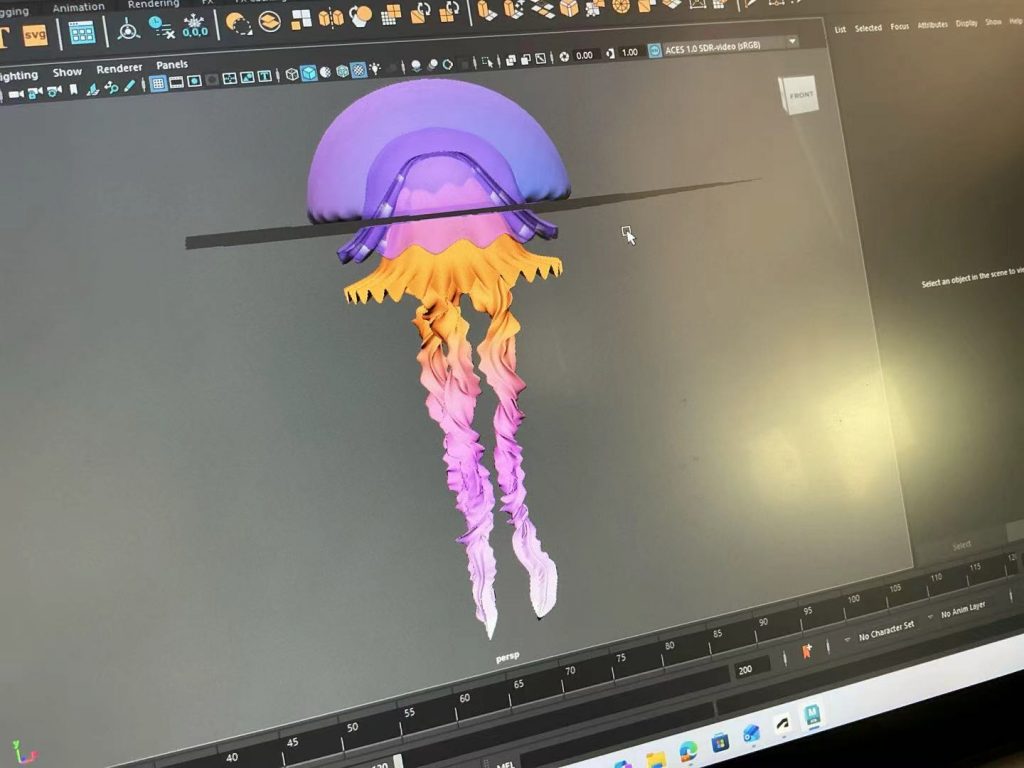
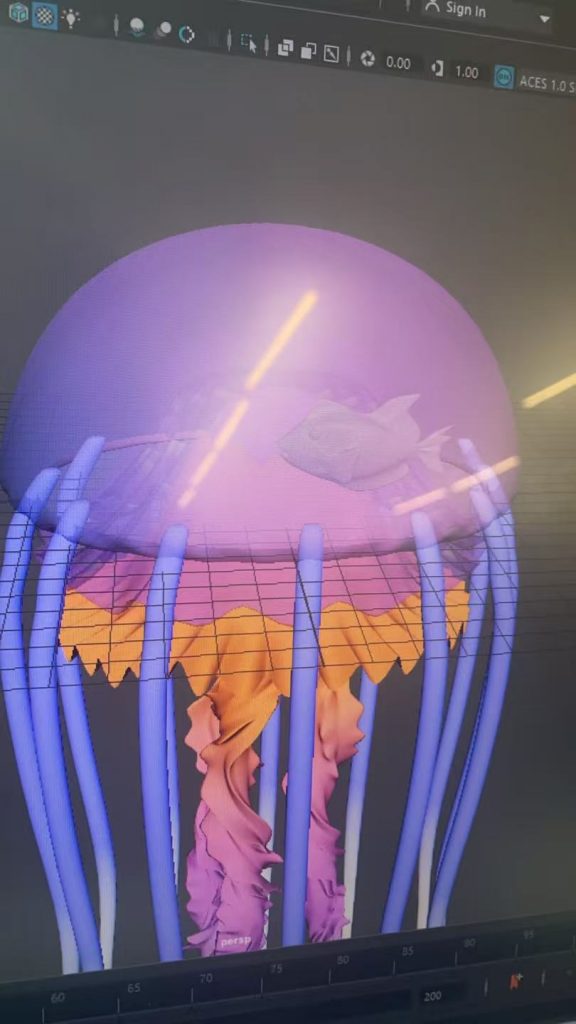
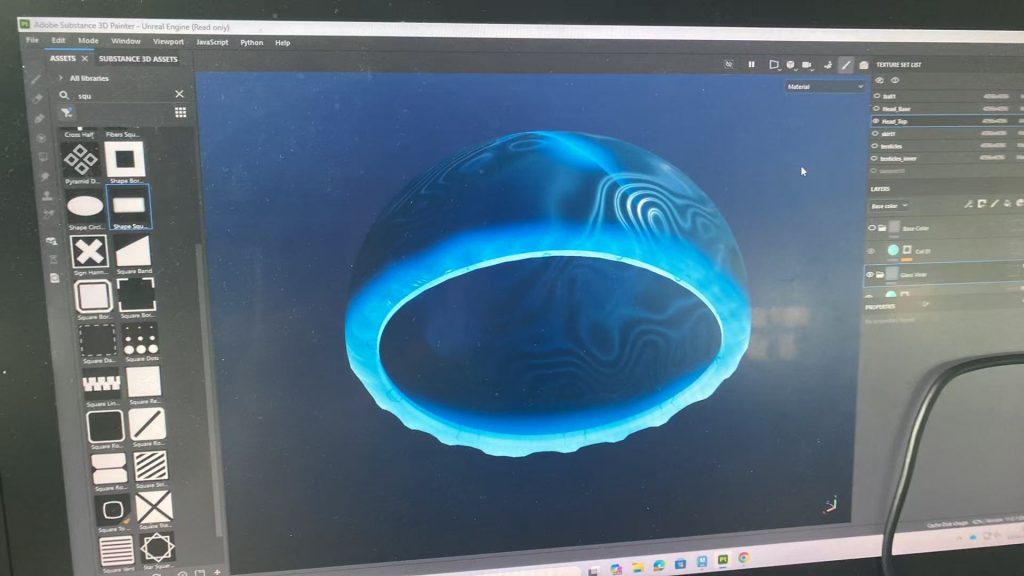
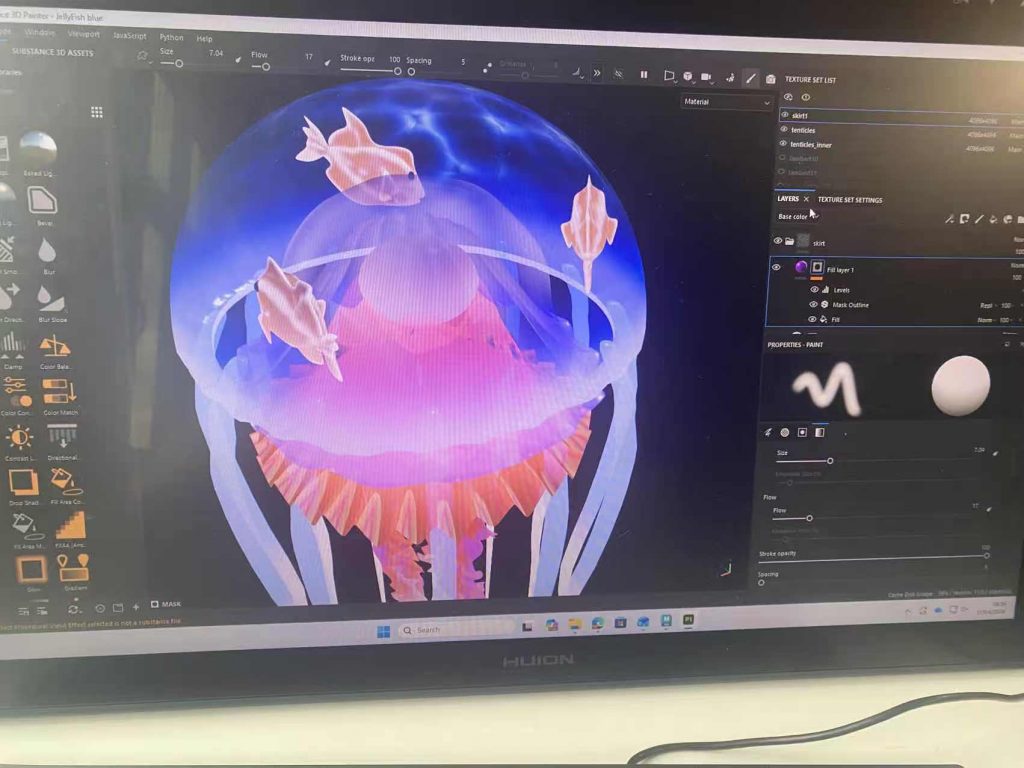
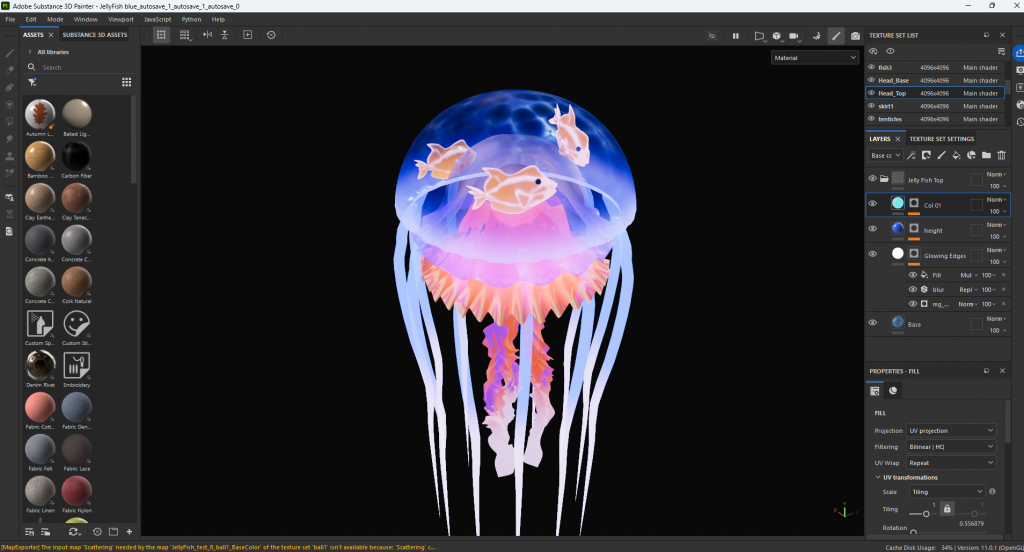
After finishing the modeling and UV unwrapping, I moved on to creating materials for my jellyfish in Substance Painter. I wanted to achieve a semi-transparent look with flowing, glowing, nerve-like patterns on the surface, and a soft, jellyfish-like texture. Following my teacher’s suggestion, I started with the built-in glass material in Substance Painter, added some roughness maps on top, and kept tweaking the settings until I was satisfied with the final result.
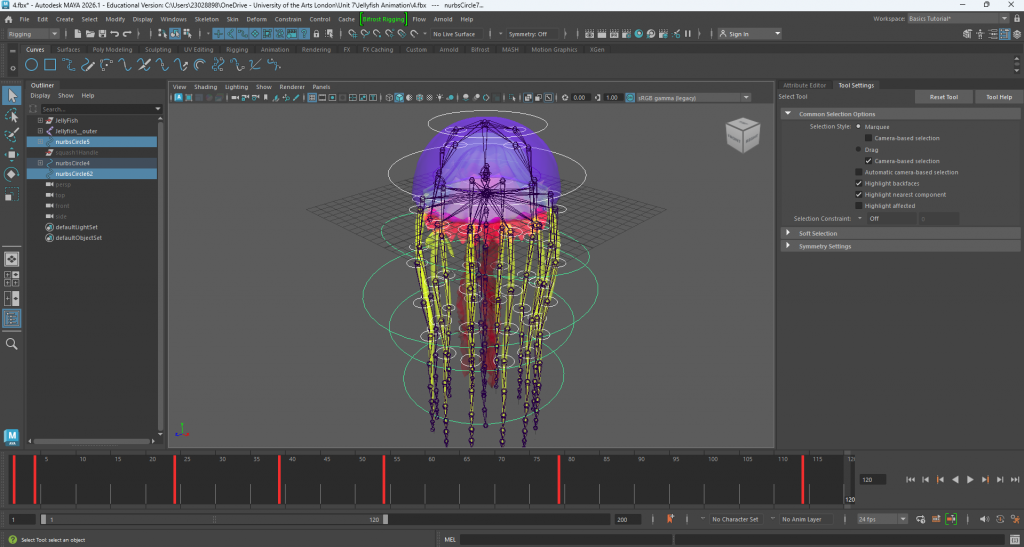
Next, I began rigging the jellyfish in Maya to prepare for animation. I ran into several challenges here too — for example, the tentacles moved very stiffly, the overall motion wasn’t smooth, and it just didn’t look the way I wanted. Originally, I planned to add just one large master controller so I could move all the tentacles at once while animating, which would save a lot of work. But I soon realized that wouldn’t work, because moving everything together only allowed for simple up-down and left-right motions, not the inward contraction and outward expansion I wanted. With my teacher’s help and advice, I made significant changes to the skeleton and controllers. I added individual bones and controllers to each tentacle so they could move independently — by controlling each one to contract inward, I could finally achieve the effect I wanted. The trade-off was that animating took much more time. Finally, I imported the finished animation and model into Unreal Engine and combined them with my materials to create the final piece.
This project taught me so much — Maya modeling, rigging, material creation in Substance Painter, and the final presentation in UE5. All of it was fascinating and incredibly rewarding. I truly enjoyed the process of making this jellyfish. Running into problems and solving them helped me learn a great deal, and seeing the beautiful final result gave me a real sense of achievement.
Leave a Reply